
Tropical Estuaries

New TROPECOS data paper in JGR-Biogeosciences: A Decade of Biogeochemical Monitoring in the Tropical Urban Saigon-Dong Nai River-Estuary Continuum, Vietnam by Le et al.
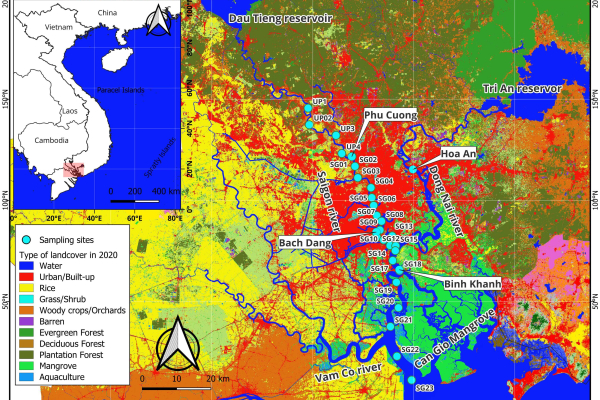
A quality-controlled, 10-year (2015–2025) biogeochemical dataset was published for the Saigon-Dong Nai River-estuary continuum in Ho Chi Minh City, Vietnam, addressing a critical observational gap in tropical Southeast Asia. The observing program couples a biweekly time series at four fixed stations with seasonal longitudinal transects across 27 sites, encompassing over 19,800 observations of physical parameters, nutrients, organic carbon, and chlorophyll-a.
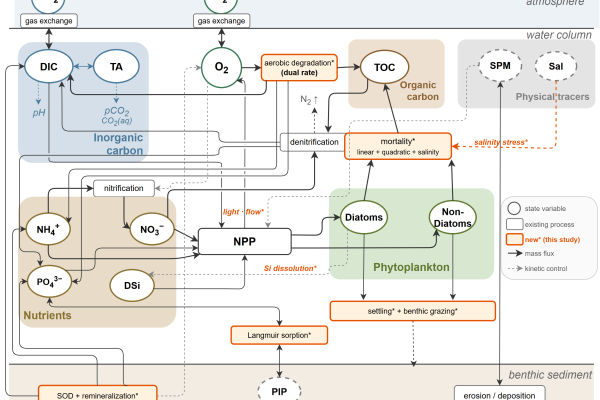
New TROPECOS paper in Ecological Modelling : Evidence of hydrodynamic control of phytoplankton seasonality in a tropical urban estuary by Nguyen et al.

The proximate controls on phytoplankton blooms and carbon dynamics were investigated in the eutrophic, wastewater-impacted Saigon River Estuary (Ho Chi Minh City, Vietnam) using a transient 1D reactive-transport model (C-GEM) evaluated against 24 months of monitoring data.

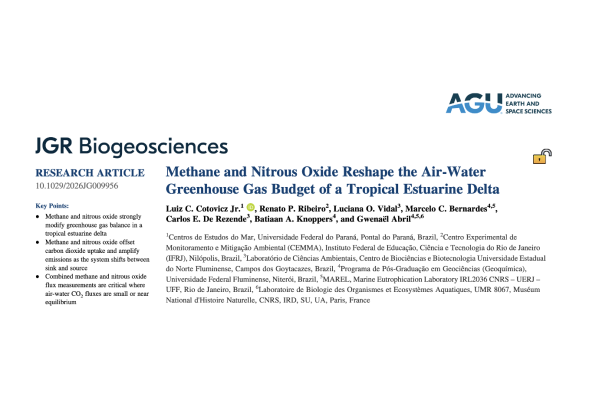
New TROPECOS paper in Journal of Geophysical Research "Methane and nitrous oxide reshape the air‐water greenhouse gas budget of a tropical estuarine delta"

Estuaries exchange greenhouse gases with the atmosphere and can either potentially warm or cool the climate. Most studies focus on CO2, but other gases such as CH4 and N2O can also be important. In several tropical deltas, mixing between river water and sea water can lower CO2 levels, leading these systems to act as CO2 sinks even without biological uptake. Here, we measured air‐water CH4 and N2O fluxes in a tropical estuarine delta in Brazil and combined these data with CO2 flux measurements collected at the same time and locations.