Scientific output

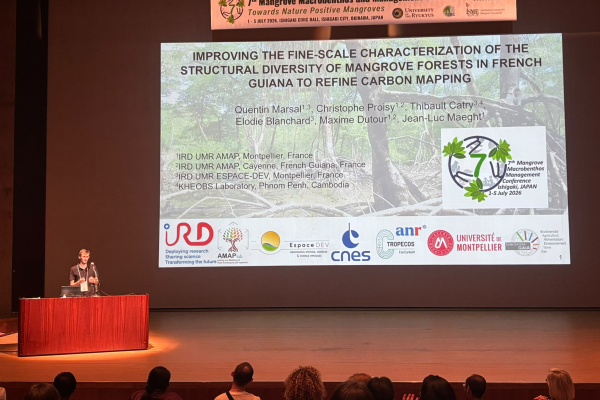
Presentation of Quentin Marsal at the 7th Mangrove Macrobenthos and Management Conference (MMM7)

7th Mangrove Macrobenthos and Management Conference (MMM7)

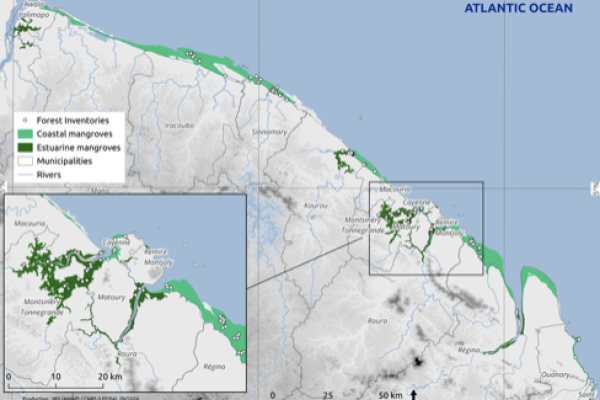
IMPROVING THE FINE-SCALE CHARACTERIZATION OF THE STRUCTURAL DIVERSITY OF MANGROVE FORESTS IN FRENCH GUIANA TO REFINE CARBON MAPPING

By Quentin Marsal (1,3), Christophe Proisy (1,2), Thibault Catry (3,4), Elodie Blanchard (3), Maxime Dutour (1,2) and Jean-Luc Maeght (1)

1: IRD UMR AMAP, Montpellier, France

2: IRD UMR AMAP, Cayenne, French Guiana, France

3: IRD UMR ESPACE-DEV, Montpellier, France

4: KHEOBS Laboratory, Phnom Penh, Cambodia

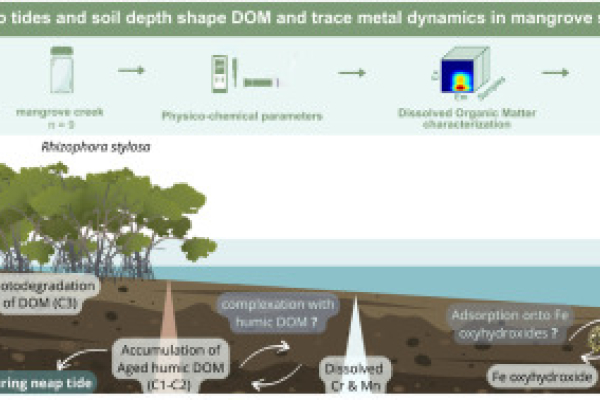
New TROPECOS paper in Estuarine Coastal and Shelf Science "Vertical and tidal variability of dissolved organic matter in mangrove soils: influence on dissolved trace metal dynamics"

  • Dissolved organic carbon content is higher in deeper soil layers.
  • The deep dissolved organic matter is older and more humified than at the surface.
  • The vertical gradients studied are amplified during neap tides.
  • Cr and Mn follow the dissolved organic carbon vertical gradient.
  • Ni and Mo follow an opposite vertical gradient to dissolved organic carbon.

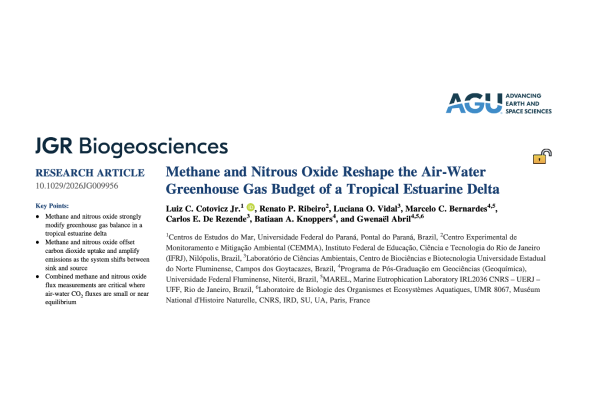
New TROPECOS paper in Journal of Geophysical Research "Methane and nitrous oxide reshape the air‐water greenhouse gas budget of a tropical estuarine delta"

Estuaries exchange greenhouse gases with the atmosphere and can either potentially warm or cool the climate. Most studies focus on CO2, but other gases such as CH4 and N2O can also be important. In several tropical deltas, mixing between river water and sea water can lower CO2 levels, leading these systems to act as CO2 sinks even without biological uptake. Here, we measured air‐water CH4 and N2O fluxes in a tropical estuarine delta in Brazil and combined these data with CO2 flux measurements collected at the same time and locations.