TROPECOS News

New TROPECOS paper in Estuarine Coastal and Shelf Science "Vertical and tidal variability of dissolved organic matter in mangrove soils: influence on dissolved trace metal dynamics"

  • Dissolved organic carbon content is higher in deeper soil layers.
  • The deep dissolved organic matter is older and more humified than at the surface.
  • The vertical gradients studied are amplified during neap tides.
  • Cr and Mn follow the dissolved organic carbon vertical gradient.
  • Ni and Mo follow an opposite vertical gradient to dissolved organic carbon.

New TROPECOS paper in Journal of Geophysical Research "Methane and nitrous oxide reshape the air‐water greenhouse gas budget of a tropical estuarine delta"

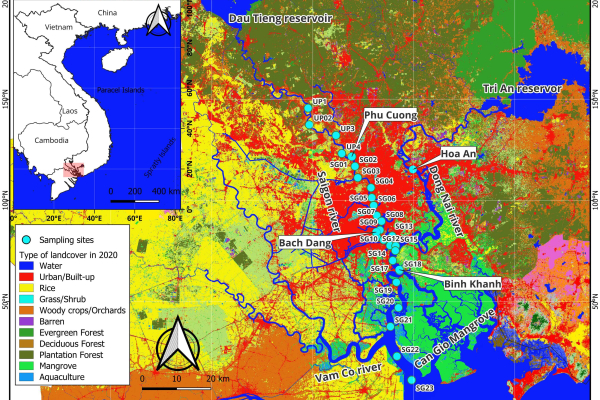
Estuaries exchange greenhouse gases with the atmosphere and can either potentially warm or cool the climate. Most studies focus on CO2, but other gases such as CH4 and N2O can also be important. In several tropical deltas, mixing between river water and sea water can lower CO2 levels, leading these systems to act as CO2 sinks even without biological uptake. Here, we measured air‐water CH4 and N2O fluxes in a tropical estuarine delta in Brazil and combined these data with CO2 flux measurements collected at the same time and locations.

Field work in Marapanim and Salinopolis, Brazil

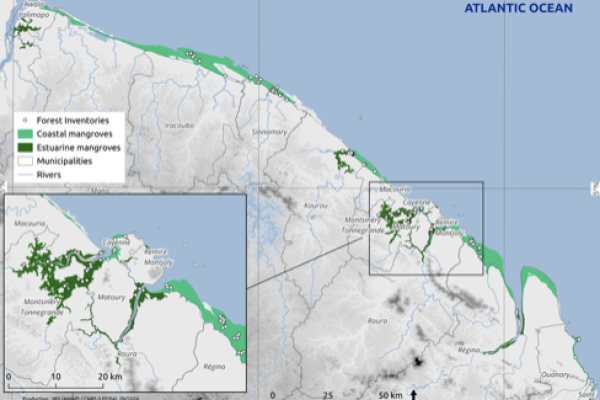
In June 2026, TROPECOS scientists from BOREA, iEES, UFF, MPEG and UFPA have sampled sediments cores, litters and litter bags in two Amazonian mangroves, Marapanim a preserved site and Salinopolis a site impacted by urbanization and sewage loads. In addition, forest inventories were performed in Marapanim.  

New field work in Marapanim, Pará, Brazil

The third TROPECOS field work in mangroves of Marapanim Pará (19 Sep. 2025 – 3 Oct. 2025, involved 7 research scientists and students from BOREA, MPEG, UFF and UFPA. We measured gas fluxes in mangrove soils and waters, dissolved carbon concentrations and tidal exchanges, isotopic composition of dissolved inorganic carbon and methane, and litter fall. A world record of tidal variation of pCO2 in a mangrove tidal creek was obtained during equinox spring tides, with values lower than 900 ppmv at high tide and higher than 9 000 ppmv at low tide.  

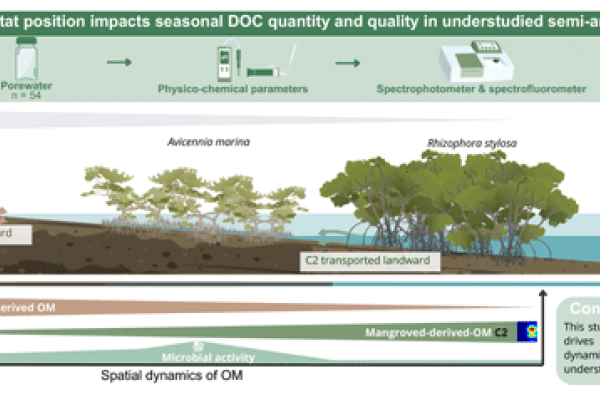
New Publication: "Variability of the optical signatures of dissolved organic matter in soils of different mangrove stands (Ouvéa, New Caledonia)” Environmental Science and Pollution Research

TROPECOS scientists involved in WP3 reveal that the composition of dissolved organic matter (DOM) in mangrove soils is strongly influenced by mangrove species and their biological traits, including mycorrhizal associations.

This is crucial because DOM plays a key role in carbon cycling and nutrient export from mangroves. These findings highlight that understanding species-specific DOM dynamics is essential to better assess carbon fluxes and the functioning of atoll mangrove ecosystems.

New publication: "The nature of soil blue carbon varies across mangrove geomorphic settings" Communications Earth & Environment.


TROPECOS Scientists involved in WP2  show that the nature of mangrove soil carbon varies significantly depending on the coastal landscape where mangroves grow. These findings challenge the "one-size-fits-all" approach to mangrove conservation and restoration for blue C, with major implications for climate policy and mangrove restoration projects.